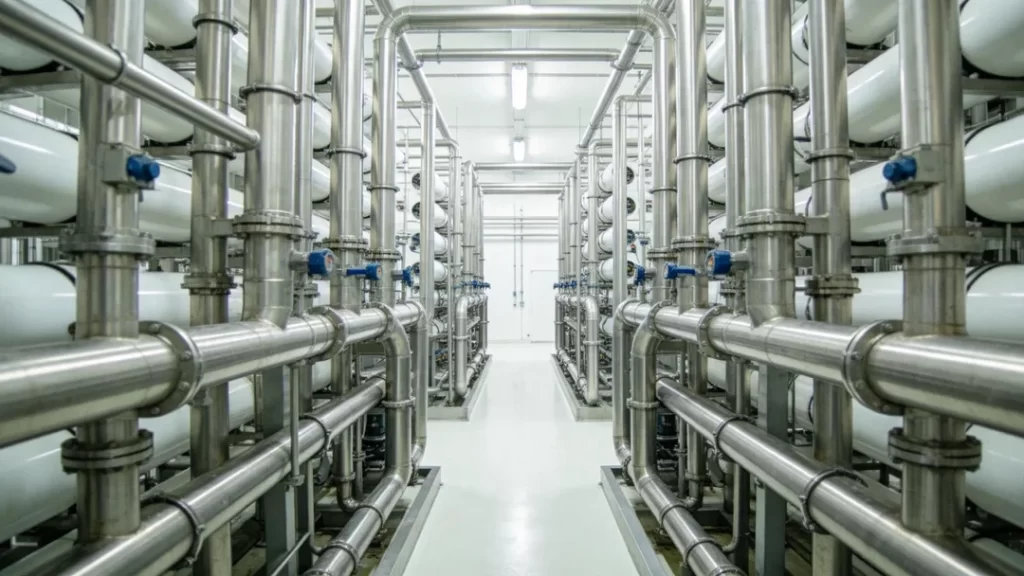
Guide des connaissances sur le système de traitement de l'eau par EDI
Les systèmes de traitement de l'eau par électrodéionisation (EDI) assurent une élimination continue et sans produits chimiques des ions dissous afin de produire une eau de haute pureté pour les applications industrielles. La compréhension des principes de l'EDI, de la structure des modules et des conditions de fonctionnement aide les utilisateurs à concevoir des étapes de polissage fiables après l'osmose inverse.
Articles connexes sur les connaissances du système de traitement de l'eau EDI
Les connaissances sur le système de traitement de l'eau EDI peuvent soutenir la sélection du système
Les connaissances sur le système de traitement de l'eau EDI permettent une sélection précise du système en clarifiant les exigences de l'eau d'alimentation, les objectifs de conductivité, la capacité des modules et les paramètres d'exploitation, ce qui permet aux ingénieurs d'adapter les configurations EDI aux performances de l'osmose inverse en amont et aux besoins de pureté du processus en aval.
Sélection et dimensionnement du module EDI
La sélection du module EDI approprié nécessite l'évaluation de la qualité de l'eau d'entrée, de la température, des fuites de dureté provenant de l'osmose inverse et de la résistivité de sortie souhaitée, en garantissant une surface de membrane et une densité de courant suffisantes pour maintenir une efficacité d'élimination des ions stable, prévenir l'entartrage ou la polarisation et obtenir une production continue d'eau de haute pureté dans des conditions variables de charge et de fonctionnement.
Intégration avec les systèmes d'osmose inverse et de prétraitement
Une intégration efficace de l'EDI dépend d'une qualité stable du perméat d'osmose inverse, de faibles niveaux de CO₂ et d'un prétraitement fiable tel que le dégazage ou la filtration de polissage, ce qui permet à l'unité EDI de fonctionner dans les limites optimales de conductivité et de silice, de réduire la consommation d'énergie, de prolonger la durée de vie des modules et de fournir une qualité constante d'eau ultrapure pour les applications industrielles ou de procédé.





 French